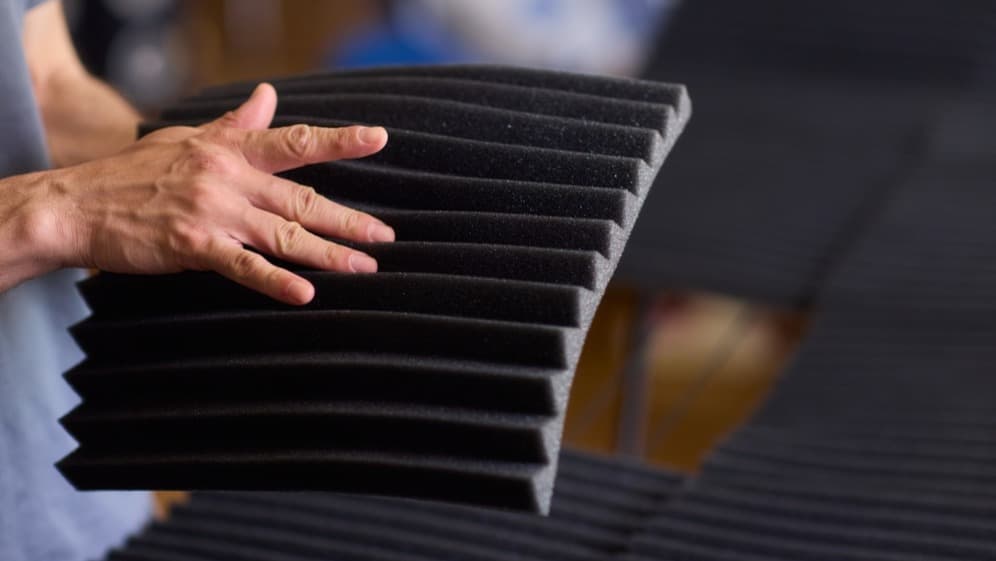
Soundproofing panels block sound between spaces, while acoustic foam reduces echo within a room. Choose panels for noise control across rooms and foam for improving sound clarity inside spaces.
Walk into any recording studio, corporate boardroom, or home theatre setup, and you will almost always spot it: foam on the walls, panels on the ceiling, or some combination of both. Most people assume these two things do the same job.
They do not.
This is one of the most persistent misconceptions in acoustic design, and it ends up costing businesses, builders, and homeowners both time and money. Getting it right starts with understanding one fundamental distinction.
It is not about soundproofing versus non-soundproofing. It is about blocking sound versus absorbing it.
Two different problems. Two different solutions.
Sound behaves a lot like water. It flows wherever there is a path, bounces off hard surfaces, builds up in corners, and travels through walls and floors depending on conditions.
These two approaches address entirely different aspects of that behaviour:
- Acoustic soundproofing panels are designed to block sound from moving between spaces. They rely on mass, density, and airtight construction to prevent airborne noise from crossing a wall or partition. The key performance metric is STC (Sound Transmission Class), which measures how effectively a barrier stops sound transmission.
- Acoustic sound-absorbing foam works entirely within a space. It does not stop sound from entering or leaving a room. It reduces reflections inside that room, controlling echo, reverberation, and background muddiness. The metric here is NRC (Noise Reduction Coefficient), where higher scores mean better absorption. Quality acoustic sound-absorbing foam typically carries an NRC between 0.7 and 1.0.
Put simply: if you want to stop your neighbour from hearing your band practice, you need soundproofing. If you want your band to hear each other clearly inside the room, you need acoustic sound-absorbing foam.
What acoustic sound-absorbing foam actually does
Open-cell polyurethane foam works by trapping sound waves within its microscopic cellular structure and converting that energy into heat through friction. The porous surface geometry is not cosmetic. Convoluted patterns like pyramids and wedges increase surface area available for sound contact, directly improving absorption.
Where acoustic foam performs best:
- Mid to high-frequency sounds above 500 Hz, covering speech, musical instruments, and ambient office noise
- Recording and broadcasting studios, home theatres, call centres, and classrooms
- Generator enclosures and engine test rooms, when engineered at higher densities
Where it has limitations:
- Deep bass, HVAC rumble, and heavy machinery vibration require far more mass than foam can provide
- Standard acoustic foam soundproofing does not stop sound from travelling through walls, floors, or structural elements
- Thin foam at 1 to 2 inches has a very limited effect below 500 Hz
Sheela Foam’s Sound Absorption Foam is engineered with convoluted and profiled geometries for exactly these environments, with consistent NRC performance across walls, ceilings, and enclosures.
Where acoustic panels for soundproofing come in
Acoustic panels for soundproofing, built from dense core materials such as rock wool, glass wool, or mineral fibre, absorb a broader frequency range than standard foam. Their mass and rigidity handle mid-range and lower-mid frequencies more effectively.
Best use cases for acoustic panels:
- Large commercial spaces, auditoriums, and multiplex cinemas
- Corporate offices and conference rooms where speech intelligibility is critical
- High-traffic environments such as schools, hospitals, and hospitality venues
- Spaces where aesthetics and acoustic performance need to work together
Fabric-wrapped acoustic panels for soundproofing can be customised in size, shape, and colour without compromising the performance underneath. Explore Sheela Foam’s full Acoustics portfolio for commercial and architectural applications.
Industrial applications: a different scale entirely
At an industrial scale, the challenge grows significantly. Manufacturing floors, generator enclosures, engine test rooms, and automotive interiors deal with sustained noise across multiple frequencies alongside physical vibration that travels through structure, not just air.
High-performance noise insulation foam needs to handle:
- Continuous mechanical vibration and structure-borne noise
- Heat cycles, oil exposure, and harsh operating conditions
- Long-term material stability without cell degradation
For applications demanding both acoustic control and fire compliance, Silentech Foam by Sheela Foam is a fire-retardant, ester-based PU foam developed using Microcellular Engineering Process technology. It delivers exceptional NRC performance even at reduced thicknesses and is purpose-built for generator canopies, acoustic enclosures, industrial silencers, and underdeck insulation.
So which one do you actually need?
| Your Situation | What You Need |
| Noise travelling between rooms or floors | Soundproofing: mass, sealing, decoupling |
| Echo, reverb, and muddiness inside a space | Acoustic sound-absorbing foam |
| Large space with speech clarity issues | Acoustic panels for soundproofing |
| Industrial or machinery noise | High-density noise insulation foam |
| All of the above | A layered approach combining both |
The most common and expensive mistake is treating these two as interchangeable. Acoustic sound-absorbing foam will not stop your neighbour from hearing you. Acoustic soundproofing panels alone will not fix a reverberant recording space.
At Sheela Foam, our acoustic portfolio covers both ends of this spectrum. From Sound Absorption Foam for studios and enclosures to Silentech Foam for demanding industrial environments, every solution is engineered to perform under real-world conditions. Understanding what you need to solve is the first step. We help with the rest.
Get in touch with our B2B team or explore the full Acoustics range to find the right fit for your environment.
